






How to use an electric wheelchair and precautions
How to use an electric wheelchair
Important: Do not attempt to operate an electric wheelchair without professional explanation or training to avoid danger.
|
Please consult before purchasing and using a wheelchair to select a more suitable product and use it correctly. In order to ensure safe use of this product, if the user’s special psychological / physiological / displacement conditions ( such as amputees, unstable sitting postures, restlessness, tension, etc.) (etc. ) or environmental factors that may cause the wheelchair to tilt or the user to fall, please purchase and install anti-reverse wheels, seat belts, or further install other safety devices. |
1. Things to note before using an electric wheelchair
1.1.1 Every time you get into or get out of a wheelchair, please do not stand on the footrests. You must step on the ground.
1.1.2 Before you get used to driving, please practice in a safe and spacious place such as a park.
1.1.3 Please use safety belts to secure users to ensure safety.
1.1.4 Make sure that all parts and screws are secure and that the front and rear fixing pins of the seat are firmly inserted into the fixing base.
11.5 Make sure the battery power is sufficient for use.
1.1.6 When using pneumatic tires, please maintain the specified tire pressure. Abnormal tire pressure may cause unstable driving or excessive current consumption.
1.1.7 Every time you sit in or get up from the wheelchair, please make sure that the clutch levers (manual/electric) on both sides of the rear are in the gear (electric) state.
1.1.8 Confirm that the anti-reverse wheel is installed.
1.2 Precautions when driving
1.2.1 Generally, the load capacity of wheelchairs is 120 KG. Therefore, please avoid walking on steep slopes, sloping ground, high steps, ditches, and avoid walking sideways or diagonally on steep sloping ground.
1.2.2 Practice driving fully in a safe place and remember the feeling of traveling, stopping and turning. When you first go out on the road, please walk with a caregiver and make sure it is safe.
1.2.3 Please obey traffic rules as a pedestrian and not as a motorcyclist.
1.2.4 Please walk on sidewalks and zebra crossings, and keep to the right.
1.2.5 Please avoid snaking or rapid turns.
1.2.6 Please avoid walking in the following situations or places, and please go with a caregiver.
1.2.6.1 Walking in bad weather (rain, fog, strong wind, snow, etc.). In case it gets wet, wipe it dry immediately.
1.2.6.2 Walking on bad roads (mud, snowy roads, sand roads, gravel roads).
1.2.6.3 Walking on roads with heavy traffic volume.
1.2.6.4 Walking on shoulder roads without fences in side ditches, ponds, etc.
1.2.6.5 When it is necessary to cross a railway/road level crossing, please pause in front of the road level crossing and confirm that it is safe to go left and right, that the railway will not get stuck behind the wheels, and that you must proceed at right angles to the railway. Please follow this procedure when crossing obstacles such as ditches or cracks.
|
suggestion If there is a risk of the front wheel getting stuck, it is recommended to move forward in a backward manner (such as crossing railway tracks, entering and exiting subway cars, etc.). Notice Always proceed at right angles to the railway track and any obstacles, cracks and gaps, and it is strongly recommended to have a paramedic nearby to assist you. |
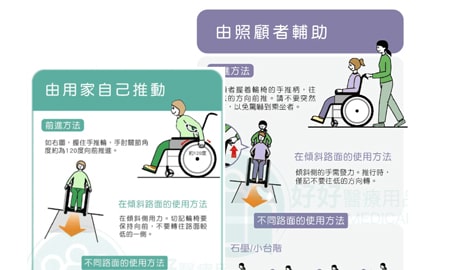
1.2.7 You must move forward when going up or downhill. When going uphill, please make sure there is at least 1 to 2 meters of flat road behind the slope. When going downhill, drive at the lowest speed. It is strictly prohibited to turn or reverse on uphill or downhill sections.
1.2.8 Please avoid crossing high steps. Generally, the height of a wheelchair climbing step is about 2-6 centimeters, so you need to pay attention to the height when crossing the steps. When crossing the steps, be sure to walk at right angles to the steps.
1.2.9 When entering and exiting a narrow passage, the width of the passage must be greater than 75 cm to allow the front wheels to maintain room for maneuver and avoid collisions to ensure structural safety.
1.2.10 If you choose to go downhill with your back turned, please make sure that relevant caregivers are present.
1.2.11 Do not use electric wheelchairs to carry items or for towing purposes.
1.2.12 When walking, avoid using mobile phones or wireless communication devices to avoid interfering with the wheelchair’s electronic control system.
1.2.13 When stopping use, please park in a safe place and switch the power switch to the (off) position.
1.2.14 User's weight - The heavier the user's weight, the lower the driving distance (depending on the battery and road conditions).
1.2.15 Personnel are prohibited from standing or jumping on the seat back cushion.
1.2.16 The circuit design of this wheelchair takes the safety of the user into consideration. Unauthorized modification of the circuit is strictly prohibited.
1.2.17 This wheelchair cannot be used as a seat on other means of transportation.
|
NOTE : Improper use will result in injury or product damage Recommendation : Follow the rules of use and be trained in using an electric wheelchair to keep the wheelchair in good condition |
2. Basic controller control
WARNING: Do not use your wheelchair until you are completely familiar with how to use the controls. All controller parameters are set at the factory to produce optimal performance under various conditions and comply with appropriate safety regulations. The circuit design on the wheelchair is planned based on your safety. Please do not change or adjust it in any way to cause damage.
2.1 Press the switch on the controller, take your hand off the control lever, and the power indicator light will appear. If the control lever is moved first and then the switch is turned on, the safety device will make the wheelchair unable to move and the power indicator light will flash in a marquee state. At this time, you can resume movement as long as you release the control stick first.
2.2 Speed adjustment: The speedometer displays the comparison value between the current speed and the top speed. You can press the acceleration (deceleration) key to increase (decrease) the speed; each press increases (decreases) 20%. If you want to fine-tune, you can press and hold the acceleration (deceleration) key. ) key to let the speedometer jump to the desired speed, then release.
2.3 Under the set speed limit, the control rod can control the direction of travel.
2.4 When starting or stopping the wheelchair, please turn the speed adjustment button to slow speed.
2.5 When you are more confident about driving, you can change the speed faster.
2.6 When using indoors, please slow down to avoid possible obstacles.
2.7 If you need to stop immediately in an emergency, just release your hand from the control lever. The fully automatic electromagnetic brake will immediately stop the wheelchair. A clicking sound on the motor indicates the brakes are operating properly.

|
1. Joystick/Control Stick |
4. Power switch |
7. Acceleration adjustment button |
|
2. Charging slot |
5. Speaker |
8. Deceleration adjustment button |
|
3. Power indicator light and status indicator light |
6. Speed indicator scale |
Do not allow anyone but you to touch the control panel. This will prevent potentially serious personal injury from being moved without your knowledge.
3.1 How to get into or out of a wheelchair
If you have special medical needs, please ask your medical staff about how to get in and out of the wheelchair.
3.1.1 The clutch is located above and behind the wheelchair motor. Please note that the clutch must be in an engaged state when sitting in or getting up to prevent danger from slipping during movement.
3.1.2 To prevent the wheelchair from leaning forward suddenly, please retract the pedals to facilitate getting up and down when sitting in or getting up from the wheelchair.
3.1.3 Every time you get in and out of the wheelchair, please pay attention to whether the front and rear wheels are in line and facing forward. The caregiver also holds the wheelchair tightly to increase stability.
3.1.4 Only when the controller power is turned off and the clutch is in gear, can you sit in or get up from the wheelchair. Please refer to 5.3.2 How to use brakes and clutches.
3.2 How to get into a wheelchair
3.2.1 Step 1: Turn off the controller power.
3.2 .2 Step 2: Lift the foot pedal and turn the calf rest and lifting feet to both sides.
3.2.3 Step 3: The user lowers the body and uses the handrails to move the body.
3.2.4 Step 4: Turn the foot pedal back to its original position and adjust the height so that the user's feet can be placed comfortably on it.
3.2 .5 Step 5: Turn on the controller power.
3.3 How to get up from a wheelchair
3.3.1 Step 1: Determine the shortest distance between the wheelchair and the destination where you want to move your body.
3.3.2 Step 2: Turn off the controller power.
3.3.3 Step 3: Lift the foot pedal and turn the calf rest and lifting feet to both sides.
3.3.4 Step 4: Move your body to the desired position on the seat.
4. Slopes, obstacles , uneven roads
There are dangers in using a wheelchair on slopes, road edges, uneven surfaces, potholes and rough roads, so use extreme caution to avoid the wheelchair tipping over. Please drive slowly and carefully when passing obstacles, and keep going straight. Otherwise, your wheelchair may be damaged or you may be harmed.
 Do not exceed the preset inclination and limits of your electric wheelchair.
 Things to note when encountering obstacles :
4.1 When approaching an obstacle, please drive slowly and cautiously and keep going straight.
4.2 Please pay special attention. When the front wheel first touches the obstacle, slowly accelerate forward, and after the rear wheel passes the obstacle, slowly decelerate forward.
4.3 When going uphill, keep your upper body straight and lean forward slightly.
4.4 Please be especially careful and slow down slowly when the front wheel first touches the obstacle, and accelerate slowly after the rear wheel passes the obstacle .
4.5 When going downhill, keep your upper body straight and lean on the back of the chair.
4.6 Please do not start or stop suddenly.
4.7 Please keep going straight when passing obstacles.
4.8 Please note that most wheelchairs are not designed for use on stairs and escalators.
 Failure to comply with the above recommendations may result in serious injury. If you violate any of the above behaviors, you will be responsible for the consequences.
related articles:
 Is the electric wheelchair suitable for users? (Even tested)
 Electric Wheelchair - Controller
 Electric Wheelchair - Lithium Battery
 Electric wheelchair - charger
 Steps for getting on an airplane with an electric wheelchair
 Electric wheelchair on board UN38.3
 How to choose a battery
 How to improve lithium battery performance
 Things to know when using a wheelchair
 Teaching skills of ascending and descending
 How to choose the right size
 Regulations and legislation regarding electric wheelchairs
 Good quality assurance of medical supplies
The contents of this website are protected by copyright and may not be reproduced without permission.