





2026 Latest|Hong Kong Electric Wheelchair Legal Guide: Laws, MTR, Buses, High-Speed Rail, and Flying – All You Need to Know | HoHo Medical

Comprehensive Guide to Electric Wheelchair Usage Regulations and Public Transport in Hong Kong (Latest Update 2026)
Regulations, MTR, Buses, High-Speed Rail, Airlines (IATA Requirements) - All You Need to Know
Electric wheelchairs are increasingly popular in Hong Kong as essential mobility aids for people with disabilities and the elderly. According to the latest guidelines from the Transport Department in 2026, electric wheelchairs are not considered motor vehicles but rather mobility aids. This means users do not need to register or obtain a license, but they must adhere to pedestrian traffic rules.
This article provides a detailed explanation of Hong Kong's electric wheelchair regulations, public transport rules, international standards, as well as purchasing and safety tips, to help you use them safely and compliantly.
Whether you are new to electric wheelchairs or seeking the latest information, this 2026 electric wheelchair usage guide is based on official documents and updates, covering buses, MTR, high-speed rail, IATA airline rules, and ISO 7176 standards. In 2025, the government stated that the "Road Traffic Ordinance" is not suitable for regulating electric wheelchairs, but the Legislative Council and the Consumer Council continue to call for enhanced safety education and regulation to address potential risks arising from their widespread use.
Overview of Hong Kong Electric Wheelchair Regulations (Registration, Medical Certificate)
In Hong Kong, the legal status of electric wheelchairs is clearly defined in the Road Traffic Ordinance (Cap. 374) and related documents. The Transport Department considers electric wheelchairs as "Electric Personal Mobility Aids" rather than motor vehicles or motorcycles. This is based on the 2020 discussion paper "Review of the Use of Electric Personal Mobility Devices in Hong Kong," which emphasizes their practical benefits for people with disabilities and the elderly. However, in 2025, the government confirmed that existing regulations are not suitable for further control.
Key Legal Points for Use in Hong Kong
| Key Point | Detailed Explanation |
|---|---|
| No registration or license required | If a medical certificate is held (provided by rehabilitation medical professionals such as the Hospital Authority Community Rehabilitation Centre), the electric wheelchair is considered a personal medical mobility device. No registration with the Transport Department is required. |
| Scope of use restrictions | Only for use on pavements; not permitted on roads, cycle tracks, or carriageways. Users are considered pedestrians and must comply with pedestrian traffic rules. |
| Potential illegal acts | Under Section 4(8) of the Summary Offences Ordinance (Cap. 228), reckless driving causing public danger or obstruction (e.g., speeding or without obvious necessity) may result in charges of "driving or riding on a pavement" or "causing damage in a public place," with a maximum fine of $2,000 or 3 months imprisonment. |
| Medical certificate requirement | Users must demonstrate mobility impairment and normal cognitive function. The Hospital Authority provides training, including safe operation and handling outdoor obstacles. |
| Latest developments in 2026 | The government is reviewing regulations, including speed limits and safety education. The Legislative Council is discussing proposals to add dedicated pathways in new development areas to reduce conflicts; practicing barristers state that even driving onto the road is not necessarily illegal, but call for enhanced education. |
- If regulations are violated, the police may enforce them. It is recommended to consult the Transport Department or legal advisors for the latest information.
- Related Article: Electric Wheelchair Legal Regulation and Legislation
Electric Wheelchairs on Buses (Rehab Buses + Low-Floor Buses)
Hong Kong's bus services are wheelchair-friendly, especially low-floor buses and rehab buses.
Key Rules for Bus Use
| Rule Type | Detailed Explanation |
|---|---|
| Rehab Buses | Operated by the Hong Kong Society for Rehabilitation, specially designed for people with mobility impairments. Equipped with electric wheelchair lifts and securing devices. Eligibility: Hong Kong identity card holders with mobility impairments, can book scheduled pick-up services (e.g., for work, school). Reasonable fees, requires advance application. |
| Regular Buses | Low-floor buses have wheelchair spaces that can accommodate electric wheelchairs. Ramps are used for boarding, and wheelchairs must be secured with safety belts (one for the waist/back, one horizontal). During peak hours, waiting may be required. |
| Notes | The total weight of the wheelchair (including user) should not exceed the limit (varies by bus model), and carrying cargo should be avoided. Persons with disabilities can enjoy a half-price discount by presenting their Registration Card for Persons with Disabilities. |
- If assistance is needed, contact the bus company or Transport Department.
- Related article: Bus Movable Armrests, Wheelchair Zone Information, and Discounts
Electric Wheelchairs on MTR
The MTR provides accessible facilities for electric wheelchairs, but strict rules apply.
MTR Key Regulations
| Regulation Type | Detailed Explanation |
|---|---|
| Applicable persons | Only for persons with mobility impairments; staff may request proof (e.g., Registration Card for Persons with Disabilities or doctor's certificate). Children must be accompanied by an adult. |
| Dimensions and weight | Wheelchair dimensions limited to 1200mm (length) × 700mm (width), total weight (including user) not exceeding 200kg. Maximum speed 6km/h, similar to walking speed. |
| Facilities | Use wheelchair lifts, passenger lifts, or ramps. Some stations have electric wheelchair charging sockets. Escalators are prohibited. |
| Others | Wheelchairs with fuel motors are prohibited. Avoid peak hours during busy periods. |
- Safety first: Practice operating, avoid collisions.
- When taking the MTR, it is recommended to inform the duty staff.
- Related article: Electric Wheelchair MTR Dedicated Charging Sockets
Electric Wheelchairs on High-Speed Rail and Cross-Boundary Trains
The Guangzhou-Shenzhen-Hong Kong High-Speed Rail supports electric wheelchairs, but advance arrangements are required.
High-Speed Rail Procedures and Rules
| Rule Type | Detailed Explanation |
|---|---|
| Ticket purchase | Book wheelchair-accessible seats (business or first-class coaches have dedicated areas). Dimensions limited to 1200mm × 700mm. |
| Assistance | Call 2120 0888 at least 1 day in advance to book staff assistance for boarding or borrowing a wheelchair. Stations have barrier-free access and lifts. Each high-speed train has two wheelchair spaces that can be reserved. |
| Note | Prohibited from using automatic power on the platform or in the train (manual assistance required). Persons with disabilities enjoy discounts. |
- Suitable for long-distance travel, avoiding the hassle of flights.
- Related article: Detailed Procedure for Wheelchairs or Electric Wheelchairs on High-Speed Rail
Electric Wheelchairs on Planes - IATA & UN38.3 Aviation Regulations (Lithium Battery Focus)
IATA (International Air Transport Association) regulates air transport of electric wheelchairs, with a focus on battery safety.
Battery IATA Regulations
| Regulation Type | Detailed Explanation |
|---|---|
| Lithium batteries | Watt-hour (Wh) maximum not exceeding 300Wh. If two batteries, each not exceeding 160Wh. Batteries must be removable and carried in the cabin, or protected from damage when installed. |
| Type | Non-spillable lithium batteries and dry cell batteries are allowed. |
| UN38.3 Specification | Must pass UN38.3 testing, and a test certificate and label are required. |
| Procedure | Notify the airline in advance; wheelchairs can be checked free of charge. Remove batteries and carry them into the cabin. |
- Check airline policy to avoid delays.
- For details, see: Electric Wheelchair on Plane Procedure and Electric Wheelchair Lithium Battery IATA / UN38.3 Requirements
ISO 7176 International Standard for Wheelchairs Explained
ISO 7176 is a series of international wheelchair testing standards, ensuring safety and durability.
Core Parts
| Standard Part | Detailed Explanation |
|---|---|
| Static Stability (Part 1) | Tests the balance of the wheelchair when stationary. |
| Dynamic Stability (Part 2) | Evaluates stability during movement, such as tilting backward. |
| Durability (Part 8) | Includes strength, impact, and fatigue testing. |
| Others | Dimensional measurement (Part 7), use as a car seat (Part 19), terminology (Part 26). |
- It is recommended to purchase ISO 7176 compliant wheelchairs in Hong Kong. The government is developing consumer guidelines.
- Related article: ISO 7176 & International Safety Regulations
Electric Wheelchair Safety Precautions
Safety first, avoid accidents.
Precautions before use
- Check battery, parts, tire pressure; fasten seat belt; install anti-tip wheels.
- Check manual/electric mode switching, and if immediate braking is possible.
Precautions while driving
- Observe speed limits, avoid steep slopes/ditches; obey pedestrian rules; do not use mobile phones; have an escort in bad weather.
Precautions when encountering obstacles
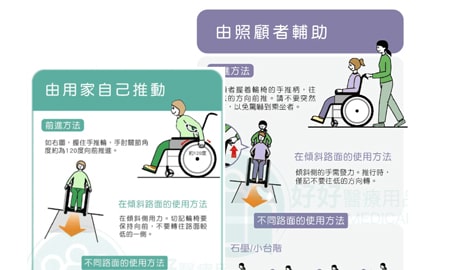
- Slow down and go straight; lean forward when going uphill, lean back when going downhill; do not brake suddenly.
Road precautions
- Only for use on pavements.
- Respect and obey pedestrian traffic rules.
Before using an electric wheelchair, it is recommended to receive training from a Hospital Authority therapist or a specialized store to improve skills.
For further assistance, please contact our experts or professional organizations. This article is based on the latest official information and is regularly updated.