





How to choose a manual wheelchair (detailed instructions with pictures)
How to Choose a Manual Wheelchair (Detailed Guide with Illustrations)

If you are a wheelchair user or caregiver who needs a wheelchair for the long or short term, the following 5 key points (size, purpose, rear wheel size, price/brand, safety certification) will help you choose the most suitable wheelchair.
There is an endless variety of wheelchairs on the market, including large-wheel/small-wheel, electric/manual, lightweight/functional, and active wheelchairs, among various brands and features. Prices vary greatly, ranging from a few hundred to over ten thousand dollars per wheelchair.


The following 5 steps can help you select a suitable wheelchair in 5 minutes, allowing you to better understand how to choose the right one:
1. Appropriate Size
When choosing, pay attention to the seat width, depth, height, backrest height, and armrest height. It is recommended to try sitting in person at a physical store.
- A well-fitting wheelchair provides high comfort; a poorly-fitting one may affect health or cause chronic body strain.
- Generally, mainstream wheelchairs in Hong Kong use a standard seat width of 43cm (17”) or 46cm (18”), which suits most Hong Kong users (Asians). If special seat dimensions are needed, customisation can be inquired about.
2. Purpose (Required Functions)
First, consider the user's condition and intended use. Refer to the selection recommendations for different purposes below:
Frame Design and Materials:
- Frame materials can be made of steel, aluminum alloy, titanium alloy, or even carbon fiber.
- PU solid tires, inflatable tires and thickened tires, ergonomically designed seats and cushions, thickened cushions, genuine UK PG controllers, lithium batteries, etc.
Diverse Functions:
- Reclining, adjustable back tension backrest, orthopedic footrests or removable footrests, flip-up or detachable armrests, handle-style or foot pedal brake systems, or foldable backrests for storage, etc.
Electric Wheelchairs:
- Suitable for individuals who need to use a wheelchair long-term, can operate the wheelchair themselves, and go out independently.
Manual Wheelchairs:
- Suitable for individuals with short-term injuries (e.g., fracture patients choosing orthopedic wheelchairs), those who have a caregiver, or users with sufficient upper limb strength to self-propel the wheelchair.
3. Large or Small Rear Wheels
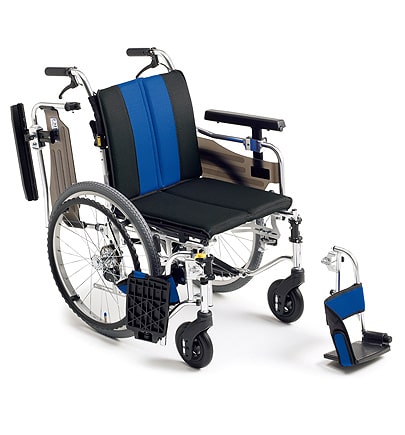
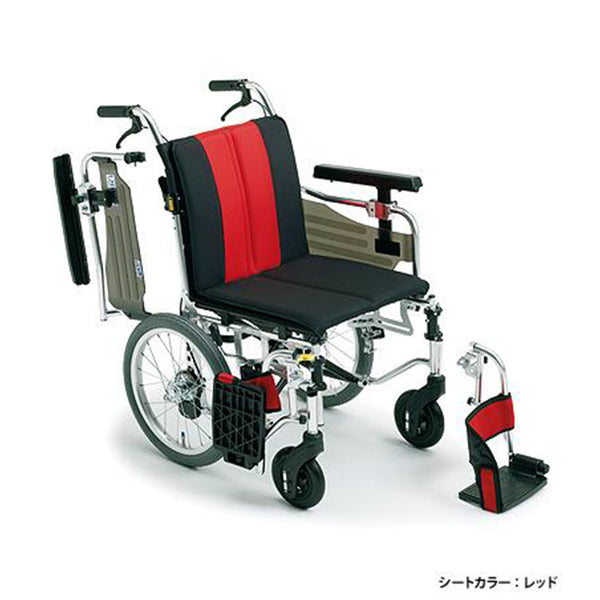
- User's autonomy of movement — With large wheels, the user can propel themselves. Small wheels do not allow this.
- User's living space — Large wheels require a larger turning radius, while small wheels require a smaller one.
Suitable for users of large rear-wheel wheelchairs:
- Users with sufficient upper limb strength to propel the wheelchair themselves, those with heavier body weight, and those who travel on rougher roads.
Suitable for users of small rear-wheel wheelchairs:
- When the wheelchair is pushed by a caregiver, when the wheelchair needs to be transported into and out of a car, when transfers to and from bed are needed, and when household passages are narrow.
Debunking the myth of large vs. small wheels:
X Large wheels are more stable - Stability does not depend on the size of the rear wheels, but on the distance between the front and rear wheels and the contact area of the tires with the ground.
X Large wheels are sturdier - Sturdiness depends on the material and thickness of the tires.
X Large wheels are easier to push - Large wheels are not necessarily easier to push, just more effortless. For the same distance, large wheels roll two turns, while small wheels roll four turns. For caregivers, pushing is more effortless. How easy it is to push depends on the wheel bearings.
Note: When choosing a wheelchair, remember not to fall into the misconception that bigger wheels are always better. Large wheels are more convenient for propulsion, but they relatively affect turning and transfer space.
4. Price
Three main factors influence price — function, material (directly affects weight), and brand quality
- The more features, higher quality materials, and better brand, the higher the price will naturally be.
- It is rare to find wheelchairs that are low in price, high in function, and good in quality.
Brand Quality:
- Mainstream manual wheelchair brands in Hong Kong primarily come from Japan (e.g., Miki, Nissin, Ichigo Ichie) and Taiwan (Karma, Merits). Their quality is usually superior to mainland Chinese brands.
- Electric wheelchairs mainly from Taiwan, the United States, and Europe are generally superior to those from China.
5. Safety Certification and Durability
Wheelchair weight significantly impacts caregivers. Besides the burden when pushing, it also greatly affects the feasibility and safety of folding and transporting the wheelchair. Wheelchairs made of ultra-light materials can prevent caregivers from injury and strain during transport.
- Certifications include: ISO, FDA, CE, JIS T 9201, etc.
The quality of the frame design, body materials, and accessories (such as cushions, batteries, and controllers) also affects the sturdiness and durability of the wheelchair. Wheelchairs that pass inspections and obtain professional certifications effectively ensure user safety.
The above are basic selection criteria. We recommend visiting our company showroom for free training. Our specialists will assess the user's needs and usage environment, then provide more targeted advice and tips.
For professional advice and personalized recommendations, please call 35680755 to contact our team.
All rights reserved. Professionals who wish to use this content are welcome to inquire.
Related Content: