





Is the electric wheelchair overturned because it is light? Teaching techniques of continuous uphill and downhill slopes
Does the weight of an electric wheelchair, whether light or heavy, increase the risk of tipping over when going up or down slopes?
Recently, a customer asked: If an electric wheelchair is lightweight, will it tip over when going up or down a slope? If someone says yes, we can teach them a thing or two. The answer is: No. If lightweight electric wheelchairs were to tip over, then buses would never tip over, and bicycles shouldn't be able to go up slopes, right? Actually, the reason for tipping over is the center of gravity, user attitude, and knowledge!

From a physics perspective:
When going up or down a slope, the force applied to the wheelchair can be separated into two forces: gravity (F weight) and the user's applied force (F applied). Gravity can be further divided into the force acting on a flat surface (F ground) and the force moving down the slope (F downhill). Temporarily ignoring friction, as when the wheelchair tips over, the front wheel becomes the pivot point, and friction is along the same line as the wheel, so there's no moment and it won't tip over.
Let's use going downhill as a verification scenario, because the user's acceleration and the downhill force are in the same direction. When going uphill, the user's upward acceleration and the downhill force somewhat cancel each other out, which also explains why there's less chance of tipping over when going uphill.
Force diagram when going downhill:

As mentioned above, we're talking about moment (or torque); to make something turn, we need a moment. To make a wheelchair tip over, we need a positive moment.
Moment is: The force acting on a point, multiplied by the distance between this point of force and the pivot point. For example: when we open or close a door, the force acts on the handle, and the pivot point is the hinge. This moment helps to open and close the door. Conversely, if we apply force near the hinge, it will be very difficult to open or close the door because the distance between the points is small, resulting in a very small moment.
On a side note, this means that the closer the wheelchair's center of gravity is to the ground, the less moment it has to tip over.

Alright, let's draw some diagrams, do some calculations, and analyze:
The length of the wheelchair's wheelbase is L, and its height is H. The center of gravity is generally in the middle, approximately at H / 2, L / 2.

For tipping to occur, Moment M1 must be greater than M2

M1 = ( ma + mg sin(θ) ) * H / 2
M2 = ( mg cos(θ) ) * L / 2
M1 > M2 means ( ma + mg sin(θ) ) * H / 2 > ( mg cos(θ) ) * L / 2
which means a * H + g sin(θ) * H > (g cos(θ) ) * L
which means a > g (cos(θ) ) * L / H - sin(θ) )
Conclusion: An electric wheelchair tipping over on a slope is not directly related to its weight (because the weight 'm' cancels out).
And also the following results are obtained
- The greater the user's acceleration, the more likely it is to tip over (larger 'a' means a larger tipping moment).
- The steeper the angle, the less force the user needs to apply to tip over (larger 'θ', smaller 'a', can already exceed the anti-tipping moment).
- A shorter wheelbase or taller wheelchair makes it more prone to tipping (smaller L/H coefficient, easier to tip).
To prevent tipping over, we can:
- Learn how to use an electric wheelchair correctly.
- Know how to choose safe slopes to travel on.
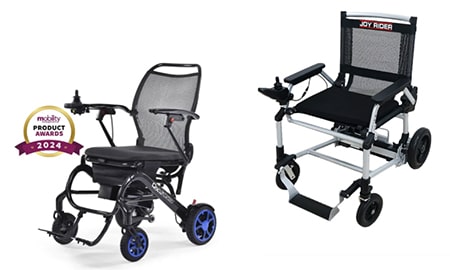
- Choose a safe and truly internationally recognized electric wheelchair. The wheelchair's center of gravity should be in the middle or rear to reduce the chance of tipping.
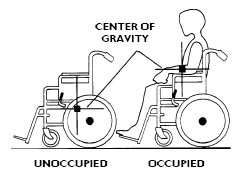
Tipping over happens because the center of gravity is too far from the center.
The more centered and lower the center of gravity is within the four wheels, the more stable and less likely it is to tip over.
Now that we understand the causes of tipping, it's also important to know how to prevent it and use the wheelchair correctly:
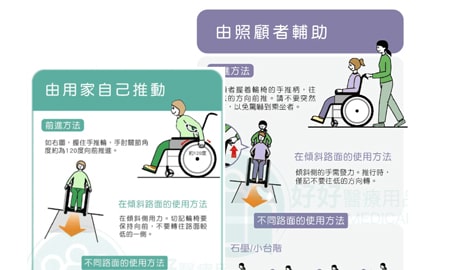
Firstly, according to the Hong Kong government's Barrier-Free Access (B.F.A.) requirements, the general ramp ratio is 1:12, meaning 1cm of height requires 12cm of length, approximately 5°. Verified electric wheelchairs or wheelchairs can navigate these. When we need to go up or down a slope, we should try to choose a path that is wide enough, straight, without hidden slopes or turns.
When going uphill:
- When going uphill, first check the road surface for obstacles, and it's best to choose a straight path.
- You will feel the wheelchair tilting backward; you can balance this by leaning your body weight forward. Try to avoid having backpacks or other loads behind the wheelchair, as this will make you more prone to tilting backward.
- Drive the wheelchair slowly to maintain control.

When going uphill, lean forward.
When going downhill:
- First check the road surface for obstacles, and it's best to choose a straight path. Check the ramp for any obstacles.
- Drive slowly to maintain control.
- The ramp may be very steep; you can compensate by shifting your body weight and leaning back.

When going downhill, lean forward. Wrapping one arm around the handle and leaning your body back against the wheelchair's backrest can help you maintain balance while descending.
Try to avoid the following paths
V-shaped uphill position:

The bottom of the ramp has a V-shaped edge. The slope and the groove create a rapidly changing incline, which can cause anti-tip wheels to get stuck and make it difficult to go uphill.
V-shaped downhill exit:

The bottom of the ramp has a V-shaped edge. If the footrests are adjusted to a lower position, they might hit, and it's also easy for the downhill force to concentrate on one side's wheel, causing the user to feel vibrations. When finishing a downhill slope, slow down and ensure both front wheels leave the ramp simultaneously.
The trick to preventing tipping is to maintain a centered center of gravity and drive slowly and carefully.
We do things with integrity, serving everyone and providing truly internationally recognized products.
We also constantly provide knowledge on using electric wheelchairs, mobility scooters, rehabilitation beds, and health information. We are continuously building knowledge about electric wheelchairs, hoping to establish an electric wheelchair university knowledge base. Your feedback is welcome.
If you want to know more about wheelchairs, click this link: How to choose and use an electric wheelchair
The content of this website is protected by copyright and may not be reproduced without permission.